
Published in the native Irish honey bee society’s (NIHBS) book
The Warré hive can be a very good tool kit to rewild Apis mellifera mellifera. I am goingtoexplain how I proceed. Rewilding bees involves selecting native local Apis mellifera mellifera, using the Darwinian selection, that can store enough honey to survive the winter. They must be able to cope with varroa as well. Basically, they have to survive on their own like in the wild. When the colonies are strong enough, they can be left to swarm to repopulate the landscape.
The warré hive is quite unique because the boxes are the smallest amongst all the other systems. It means that by stacking them up, you get a tall, vertical, narrow hive. The bees will store the honey above the cluster and it is then possible to bypass syrup feeding because the bees have access to all the stores. The small boxes mean that less energy is needed to heat the hive during the spring. This is extremely important because it will allow the bees to draw a profusion of wax in May even in cool weather.
The wax being drawn entirely by the bees gives them pristine wax. The progressive giving up of the varroa treatments will select the strongest strain. The dipping of boxes in linseed oil/beeswax will impermeabilise the walls of the hive and the propolis harvested in May’s shook swarm will be used as beneficial varnish inside the hive. The apiaries are kept very small. I have 8 apiaries for 10 to 15 hives. This will make sure that there is less competition between colonies in the spring build-up. It means less robbing and drifting as well. Permanent apiaries located away from any oil seed rape or field bean will avoid exposition to unnecessary pesticides. Instead, good diverse ecosystems will be favoured. Healthy bees selected the Darwinian way will be left to rewild the area and I do not trap them with bait hives. Let’s talk again in a more detailed way about my method of beekeeping bees with the Warré hive.
1st commandment: verticality
The Warré hive is the perfect hive to keep bees in more natural conditions. It mimics a hollow log. It is certainly not perfect but it is fairly close to the vertical cavity that you find in rotten trees.
This verticality means that the honey is stored well above the cluster. During the winter, the slow moving bees can easily climb up on the comb eating the honey whenever they need it. This particularity linked with the shape and height of the box means that it is easier to avoid sugar feeding, either syrup or fondant. This is a plus when selecting because sugar feeding can upset the queen laying. You will really select strains of bees that are in tune with the weather.
I use 8 top bars on the top box and 3 spales in the lower boxes. It is called the Japanese system or pile box hive and it has been used for centuries in Japan where they keep Apis cerana japonica.
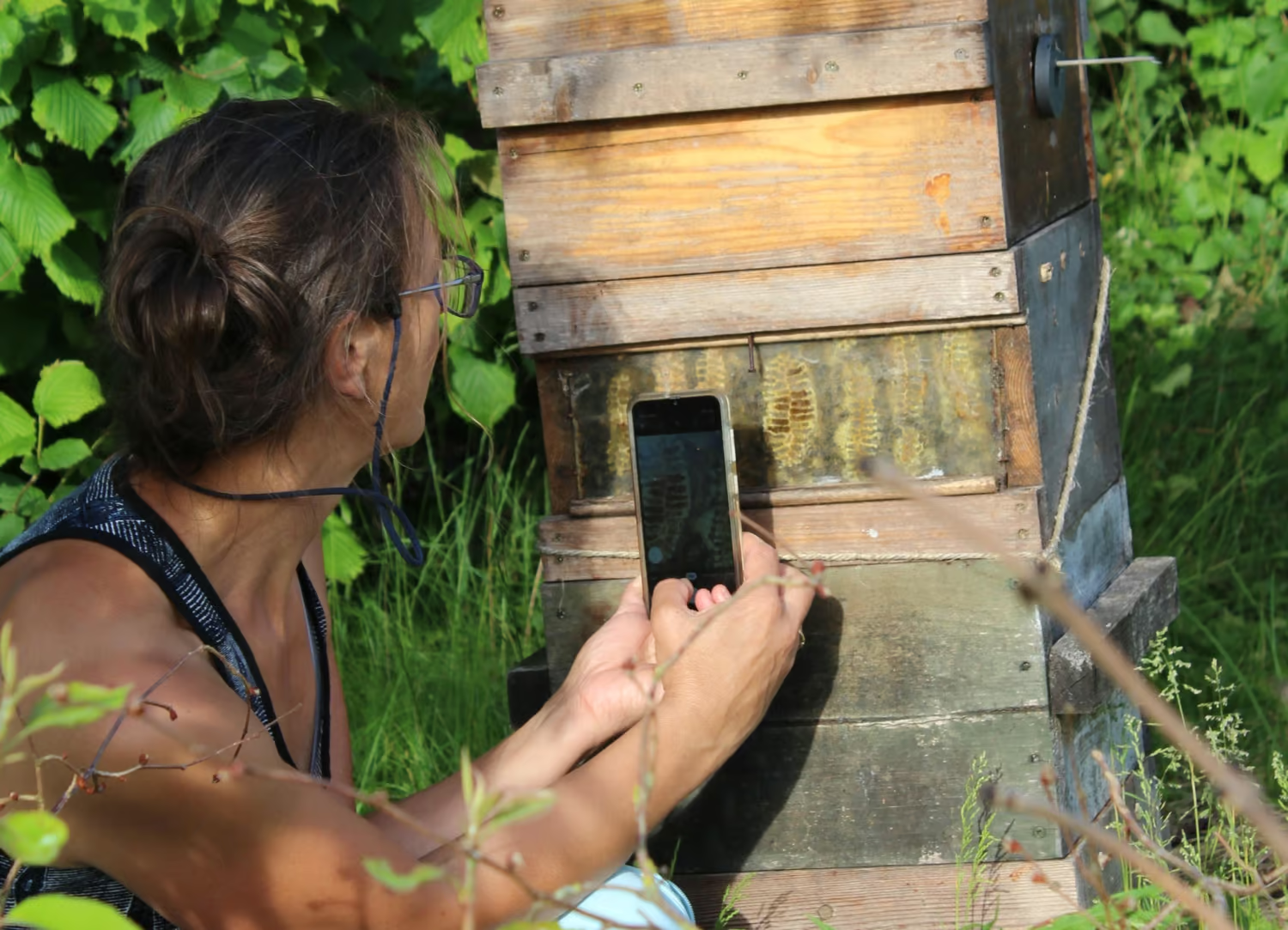
Space is usually made by adding an empty box under the brood nest. Bees can be checked when needed by simply tilting the boxes and it is then possible to see what’s going on from underneath. You will usually see the bottom of the cluster of bees but rarely the combs, except if the colony is weakened or has swarmed.
2nd commandment: small boxes
The Warré hive is made with very small boxes. The internal square measurement is 30mm by 300mm. The height of the hive is 210mm. Two Warré boxes would have roughly the volume of a national hive. I find that most of the colonies that I keep need three boxes. They will swarm every year and the secondary swarming will depend on the spring build-up and the amount of bees left after that primary swarm. They sometimes swarm again in July, especially if the hives are exposed full South facing.
Torben Shiffer has found that the worst hive in terms of thermal insulation is the ‘Bienenkiste’. It is a horizontal hive, unfortunately presented as being an “organic” hive and marketed to “save the bees”.
3rd commandment: natural wax drawing
The boxes are empty and the bees are allowed to build all their own combs. This means that they will build the cells with their own specification. They will have no restrictions to rear drones and the wax will be pristine. This is very important because some studies on French beeswax (1,2) revealed that the beeswax can contain 30 to 70 times more pesticides than the pollen or the honey. Thymol is found in high concentration in capping wax. In one study (2) on French foundations, 38 molecules were found. 28 quantified and 10 identified (trace). They were 12 molecules that are not authorised, 7 miticides, 9 fungicides, 19 insecticides, 5 weed killers and 2 surfactants.
It is quite interesting to note that they found pesticides used to preserve timber both insecticide and fungicide.
Buying foundations might be one of the many problems of commercial beekeeping. My wax is never reused and the bees are shook swarmed from time to time to get rid of the old nest. In nature, wax from dead colonies is recycled very quickly by the wax moth.
The huge advantage (for the bees) with the natural combs is that they will draw it as they need it. They will stick the combs to the walls and they will make 9 partitions between the eight combs. This makes 9 cosy gaps with little heat losses.
4th commandment: propolis envelope
The hives are carefully dipped inside and outside in hot linseed oil/beeswax. This is very important because the timber then becomes impermeable. Water will run down and it will not permeate the wood. Bees will use that water during the spring. They will propolise the walls and they will have an envelope of propolis all around their nest. The old combs must be cut and the left over on the hive walls will trigger bees to coat on more propolis. I harvest some propolis that I give back to the bees in the form of a varnish made with propolis and strong ethanol (80%). Each box is disinfected with that varnish before use. This propolis extract is very potent and it has a limiting effect on chalkbrood, AFB and many other benefits (4).
5th commandment: No sugar feeding
. The first thing I did to try to improve my stock was to stop the sugar feeding. I must say I have very small apiaries scattered around and we are lucky in County Laois to still have some good forage. Therefore I started to “create” colonies” in May. Shook swarms, natural swarming, artificial swarming were used. The aim was to get strong colonies for the winter. My beekeeping season really starts in May. By doing so, I was able to bypass sugar feeding. I had no losses due to wasps. That was a good start!! I am still proceeding that way. It gives me stronger colonies with relatively small winter losses (between 6 to 20%). Sugar feeding can be dangerous in the sense that it mimics a nectar flow and it is might be better to let the bees behaving with the climate and the natural flow. I did not realise first that I was just propping weak strains by feeding them with sugar.
6th commandment: no varroa treatment
I bought some Irish black bee queens that were actually F2 Buckfast. But as a beginner, I did not pay attention at first. Things became more complicated when I got stung, followed and attacked by those bees.
-The bees were very weak. I was counting the varroa at the time and it was not unusual to find a daily mite drop of 15 to 40 mites a day. Crawling bees with DWV were a common sight around the hive.
-I had to treat the bees against varroa at least twice a year. I was using formic acid, Thymol and then vaporised oxalic acid.
Thymol and formic acid are very disruptive for the bees. It seemed that vaporised oxalic acid was a bit more gentle.
But I have been lucky to be able to start the first year with eight colonies.
I quickly realised that selection was everything. I decided to manage my bees extensively so I would not disrupt them too much.
Then I got some Amm queens from the Galtees and Coolmore. We should not be surprised, but it is amazing to say, that all the Buckfast bees died quite quickly with this system. They are clearly unfit for our unpredictable weather.
I gradually stopped the summer apiguard treatment. I treated them for two years with vaporised oxalic acid. And then I totally stopped the treatments! I used shook swarming to “treat” the colonies that have high quantities of mites. However, I can now see that those colonies will eventually die out. It might be better to eliminate them before they collapse like suggested by Thomas D. Seeley (5).
7th commandment: Darwinian selection
I do not select for honey, I have no stud book. I just keep the survivors and the queens mate locally. I do not buy any queens anymore. It is amazing when you work with strong colonies in tune with nature how easy it is to mind them. In some apiaries, my bees have swarmed and they have successfully colonised hollow trees. They are living on their own for three years now.
8th commandment: no bait hive
To collect the swarms, I feel more and more reluctant to use bait hives. We have a huge number of colonies in and around Durrow, County Laois. It is sometimes difficult to know which bees you catch. It might be commercial bees escaping from a frame hive which are weak.
I much prefer to practice artificial swarming by driving the bees during the swarming impulse or shook swarming. I then know that they are my stock.
There is something else that leaves me very uneasy. Bait hives used intensively could be very dangerous for the wild honeybee population. We could take an example with another species in sharp decline: It is not allowed to net wild salmon anymore and you must catch and release them in many rivers because they are becoming scarce and the population is falling year after year. The population of wild honeybees in Ireland is something that we take for granted. In France, where 80% of the beekeepers work with commercial non-native bees, the winter losses are close to 80% some years. It mostly happens when the climatic conditions are difficult. Those Irish black bees should have a special status and they might have to be protected.
9th commandment: stay away from tillage crops
Tillage crops constitute a real danger for the bees and I would
never move a hive to oil seed rape or field beans. Many pesticides found in the wax is coming from fields where intensive farming is practiced. The fact that the bees are left on a monopollen diet does certainly not help the colonies as a whole. Many beekeepers in France move their bees to wild areas to avoid pollution. Their bees will ineluctably genetically pollute the stock of wild honeybees if there are some still left.
10th commandment: small apiary
I find that keeping bees in small apiaries up to maximum 3 hives helps a lot in the spring. The forage is vanishing year after year and it helps to avoid too much competition between our honeybees and the other pollinators. Torben Shiffer reckons that a conventionally managed colony will use up to 500 kilograms of nectar more than than a wild colony. Ten hives would mean that 5 tonnes of nectar is being used for our own convenience which clearly puts a lot of strain on nature (6).
- http://www.apiservices.biz/fr/articles/classes-par-popularite/2082-residus-pesticides-cire-abeille
- https://www.unaf-apiculture.info/IMG/pdf/congresclermont_3010_1pesticidescires_acaron.pdf
- https://www.researchgate.net/publication/5963084_Pesticide_residues_in_beeswax_samples_collected_from_honey_bee_colonies_Apis_mellifera_L_in_France
- https://www.ncbi.nlm.nih.gov/pmc/articles/PMC5492060/
- “ The lives of Bees” “The untold story of the Honey Bee in the Wild” Thomas D. Seeley Princeton ISBN: 978-0-691-16676-6
- https://beenature-project.com/WebRoot/Store2/Shops/6aa71639-792d-4a95-9e8c-00453bab9a49/MediaGallery/Article.pdf