Beekeeping the natural way
Even though beekeepers are at their most active in the Spring, Autumn is the time to get started on building your hive and ordering your bees for the following season. Here’s a guide to the Warré hive, an easy and biodiverse solution for novices.
Did you know? Long before pigs and poultry, bees were the first animal to have been industrially farmed, around Victorian times.
Glossary
A swarm is a large collection of bees made up of a queen bee and worker bees who have left the colony to form a new one.
A colony consists of honeybees that live in a hive.
The queen is at the heart of the colony, mother to all 50,000+ bees in the hive (a queen can lay up to 2,000 eggs in a day). If the queen dies a worker bee larvae is converted by the other bees into a queen been larvae by making it larger and adding more royal jelly.
Grafted queens are made in batches, mimicking the natural process described above. However, as they are manmade it could greatly reduce biodiversity.
A drone is a male bee.
Worker bees Any female bee that lacks the full reproductive capacity of the colony’s queen, that build the comb and collect pollen and nectar, among other tasks.
Honeycomb Where honey is stored and eggs/larvae are laid.
Wax Honeycomb building block.
Propolis Natural antibiotic secreted by the bees and applied throughout the hive. Technically it’s a resinous mixture that honeybees produce by mixing saliva and beeswax with exudate gathered from tree buds and sap flow.
Winter cluster A tight, compact cluster of honeybees that forms on the honeycomb when temperatures drop below 10 degC. This keeps the bees warm in winter.
Nectar flow Literally when nectar flows from plants; March to September in Ireland. Nectar is used to make honey, and honey is what feeds the bees in winter. Pollen feeds the larvae and the bees too.
The conventional way to get honey out of a hive is efficient but it has, in my opinion, many downsides. The first thing to consider is that the hives are quite complicated to make and rely on buying pre-made comb foundations (wax that is often loaded with pesticides). In addition you will have to feed the bees with sugar syrup which might lead to weacker bees needing chemical treaments against varroa.This is not a good chain of event!!
Biodiversity is also often compromised as a result of conventional beekeeping because it is very common to import non-native strains, and to produce grafted queens. Bees have developed to be genetically diverse to survive pests and diseases, by means of the weaker strains dying off and the stronger ones surviving, in true Darwinian style. Poor genetic diversity among bee strains reduces the likelihood of bees surviving.
Honey production therefore takes a back seat for api-centred beekeepers; the focus is instead on cultivating healthy and diverse strains of local honeybees.
The Warré system
The conventional way of beekeeping replaced the very old skep system which was used in Europe up until the end of the second world war. Back in the day every small farmer managed skeps which consisted of a small hive made from straw, twigs or even bark, protected with a cover of cow dung and placed in a bee-hole or under a roof.
As the native colonies were swarming, the numbers would then expand three-fold. The beekeeper killed these bees as the aim was to have the same amount of bees in winter and in the spring, a practice that has gone out of favour with all beekeepers for obvious reasons.
In the wake of the second world war the conventional system was devised with wax foundations providing convenient inspection chambers. But at the same time a French abbot called Warré developed a way of running self-sufficient bee colonies. Wood, wax and sugar were scarce after the war and so he devised his eponymous hive, a low cost hybrid skep/wooden hive.
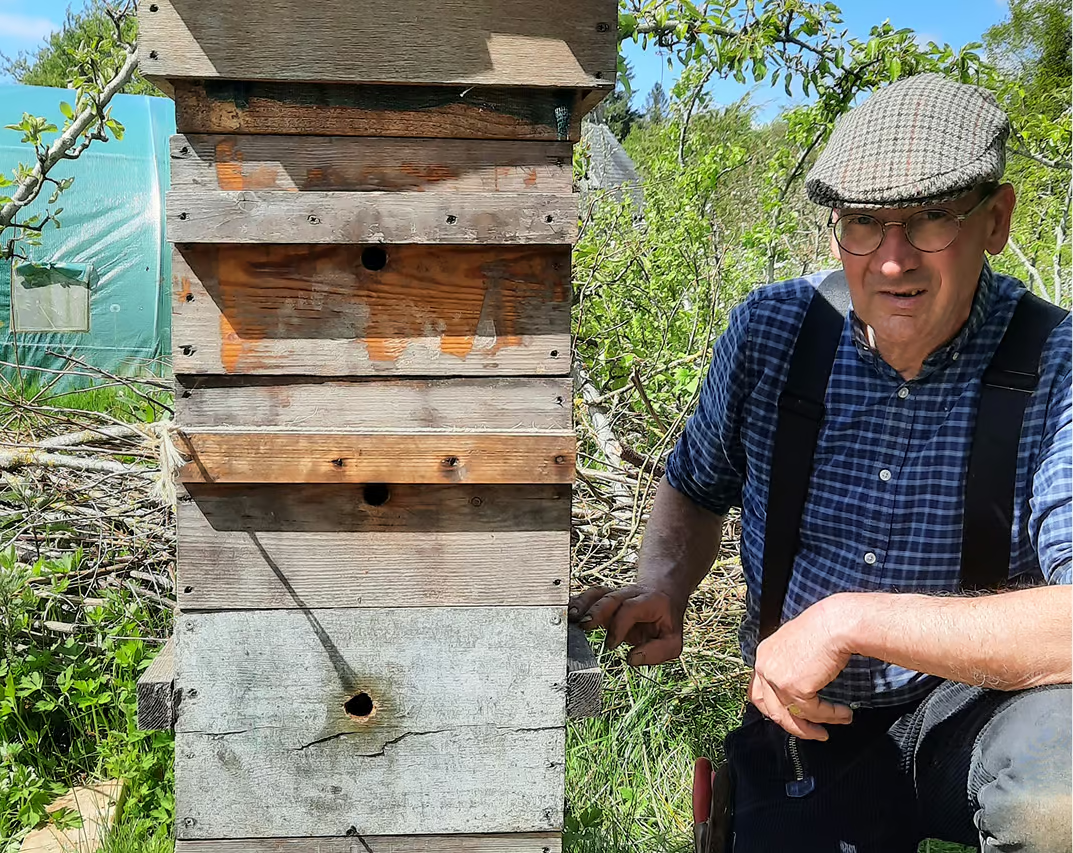
Warré trialled over 350 different designs. Whilst his is the smallest one by volume, boxes can be conveniently stacked to increase output. The hive is technically called a vertical top bar hive, (the top bar is where the bees start attaching the comb), and it mimics a vertical hollow log.
The Warré hive has the advantage of being easy to make and of keeping the core principle of skep beekeeping: the bees can make their own nest and do not rely on recycled wax foundation. Instead, bees can decide the size of the cells.
Warré discovered that most of the feral colonies would build eight combs wide and that the combs would be attached to the side. Honey is always stored on top and acts as an insulation buffer.
The nectar flow means more honey and this pushes the colony down, forcing it to build fresh combs. During the winter, the winter cluster will come up through the honey, cleaning cells that will later be used for rearing the spring bees.
Building a Warré hive
The Warré hive is made from timber, usually planed or rough white deal, ideally 25mm thick (minimum 20mm thick). Some people use planks from second hand pallets but these may have been treated with a preservative, which is the reason I avoid them. All of the elements of the Warré hive are dipped in hot linseed oil except for the roof where I use Danish oil or melted beewax. My favourite timber is rough Irish spruce. It is light and it has very good insulation properties. Rough means that bees will be more encline to coat them with beneficial propolis.
We’ll start from the bottom:
1. Hive floor
The hive floor consists of a 300x300mm square sheet of white deal with a notch at the front. I like to use a variant of the Warré base called Delon which doesn’t have a notch but instead a 7mm rim. Roger Delon’ s version of a Warre hive mimics a skep where all the walls are propolised. This is the system that I follow.
Warré leaves an air flow running through the hive from bottom to top thanks to a 100mm high vapour permeable quilt . Whereas the Roger Delon method uses a vapour impermeable crown board which means that condensation will happen at the coldest point: the entrance. Therefore, the boxes must be dipped into linseed oil/beeswax. With time the bees will coat the inside of the hive with propolis which will make it totally waterproof.
2. Boxes on top of the floor
The internal dimensions for the boxes are 300mmx300mmx210mm.
The boxes are butt-joined and easy to make. There is no need for glue; four screws or nails on each joint will do the job.
Height top bars are spaced evenly 12mm apart. They are 320mm long and they sit in a 10mm rebate or even simpler, you can sit them on a small latte.
Timber handles on each side (front and back) will help lift and tilt the boxes when needed. I usually drill a 20mm hole in the centre of the front of the box. It allows more ventilation which helps reduce swarming during the summer. Bees seem to like it a lot. A minimum of three boxes is needed by the bees to rear their brood. During the summer, a colony will expand to four to six boxes.
3. The top box fabric layer
The top box needs to be sealed at the top with fabric to prevent the bees escaping. Warré used a piece of jute called ‘the cloth’. I use a piece of windbreak netting which is very solid and useful when you have to move bees. Propolis can be easily harvested from the netting.
4. The top box insulation layer
Then comes a ‘quilt’ cover which is an insulation box placed above the bee’s nest and filled with materials like wood chips to retain the heat. Aluminium bubble insulation membrane is what I use.
5. Roof
I use the original chalet style roof because it is heavy and wind resistant, it is also a good sound barrier. The bees need to be protected from both the weather and noise. There is a ventilation opening underneath the ridge.
When should you hive the bees:
Now that you have your newly built hive, how should you start? As you are not going to be buying foundations that may be impregnated with pesticides, the bees will have to draw all the combs themselves which means you need a good flow of nectar.
The best time to house bees in an empty Warré hive is May during the hawthorn flowering season. A strong swarm will be able to build two to three elements before the winter and the colony will have plenty of stores. This is what you are aiming for. Always work with the swarming impulse.
The scent of a fresh wooden box is not very appealing to honeybees and it helps to rub the inside with lemon balm or lemon grass (called a swarm lure). A swarm is definitely the best way to start but bear in mind that it should, if possible, come from a non-swarmy strain (some types of bees will swarm very often and this leads to hives with not that many bees. I twill put the colonies under pressure in he spring time because store could be low.
The second option is to buy a 2kg pack of bees with a queen from a reputable native black bee queen breeder in May-June. Galtee bees and Coolmore are two serious suppliers. You will find a list of queen breeders from NIHBS. It’s very important that the provenance of your bees is verified to avoid genetic pollution and diseases.
The bees should be Apis Mellifera Mellifera (Native Irish Black Bees) as they retain biodiversity and perform very well in a Warré hive. In Durrow, Co Laois, I never have had to feed them in winter.
How can you manage the colony the second year?
The first year, the bees are going to build their own combs and they are going to gather enough honey for the winter and late spring the following year. They need around 9 kilo of honey, the equivalent of a small Warré box. The second year, they are going to swarm.
Some people leave them to swarm and they trap the swarm with a bait hive (a Warré hive with a swarm lure). They can be artificially swarmed by ‘driving’ the bees into an empty box placed on top of the Warre hive with the help of smoke and sound.
When are you going to harvest the honey and is it dangerous?
Late spring is the traditional time to harvest honey as it is the safest for the bees because hey have plenty of ime o replenish their stores before he winter. If you have a colony going through the winter on three boxes with 20 kg of stores, you will have the top box filled with honey in May and you could harvest at that time. But with climate change and the two horrible summers of 2023 and 2024, it is much safer to take a little crop in September. Mid-September is the perfect time, when ivy is on. Bees are busy gathering pollen and nectar which makes harvesting easier.
The Warré system requires very little manhandling but when it is necessary to open the hive, always wear protective gear – bees will aim for the eyes so a veil and straw hat are a minimum.
To keep the bees happy, it’s also best to position the hive eastwards and not mow the lawn nearby. Even though climatic conditions can agitate the bees, generally speaking native Irish black bees are quite docile and shouldn’t cause any trouble. The one thing to avoid at all costs is mixed breeds – yellow bees bred with black, for example – as these mongrels tend to be aggressive.
PARASITE
Blood suckers Varroa mites
Varroa, an Asian mite that breeds more quickly than bees, entered Ireland back in the 1990s with honeybee imports. The mites suck the bee’s fat body’s tissue and injects a cocktail of deadly viruses leading to the rapid collapse of colonies.
It is very common therefore to treat bee colonies with pesticides to kill off the varroa but this has the big disadvantage of allowing the weaker bee strains to survive. A more long-term way to control varroa, in the view of those practicing treatment-free beekeeping, is natural selection by allowing the bees that are susceptible to the parasite to die off. It is called Darwinian’s selection.